 InstaBids
What are the warning signs when hiring a concrete driveway installation contractor in Florida?
Treat a concrete driveway installation offer as a reason to slow down when the crew says it has material left over from another job, wants cash or the whole price before the old slab comes out, or asks you to get the permits; the FTC lists each among tactics to watch for, and FDACS warns against cash-only deals.
Source: FTC consumer advice on home improvement contractors, read 15 October 2026.
Source: FDACS consumer advice on service contractors, read 15 October 2026.
Key facts
- DBPR's examples of contractor work list installing a driveway or installing pavers/tile walkways, regardless of compensation, as work that does not need a DBPR license.
Source: DBPR Unlicensed Activity Program, What Requires a License, read 15 October 2026.
- FTC home improvement guidance says a written estimate should include a description of the work to be done, materials, completion date, and the price.
Source: FTC consumer advice on home improvement contractors, read 15 October 2026.
- FTC home improvement guidance lists asking you to get any required building permits among the tactics it tells homeowners to recognize.
Source: FTC consumer advice on home improvement contractors, read 15 October 2026.
- FDACS advises consumers never to agree to a cash-only deal with a service contractor.
Source: FDACS consumer advice on service contractors, read 15 October 2026.
- Florida's underground facility law says an excavator may not demolish in the area described in the required notice until all member operator underground facilities have been marked and located or removed.
Source: Florida Statutes section 556.105, Procedures, read 15 October 2026.
- EPA explains that after concrete is poured at a construction site, the chutes of ready mixed concrete trucks and hoppers of concrete pump trucks must be washed out to remove the remaining concrete before it hardens.
Source: EPA stormwater fact sheet on concrete washout, read 15 October 2026.
Which driveway quote gaps are warning signs?
Check your driveway quote for gaps: no written description of the work, materials, completion date or price, or no line for tear-out and disposal, base preparation, the concrete or paver product, joints and finish. Pause and ask before paying, because the FTC and FDACS both point homeowners toward an itemized written estimate you can compare.
Source: FTC consumer advice on home improvement contractors, read 15 October 2026.
Source: FDACS consumer advice on service contractors, read 15 October 2026.
InstaBids gets you competitive written quotes without calls or home visits to bid; contractors never pay to see a request or to bid, and there is no fee during our pilot.
Post your requestFDACS puts the itemizing step in its own words on its service contractor page, read 15 October 2026: "Ask contractors to justify their bids by listing the work/materials that are included. This allows you to make valid comparisons between estimates." On a driveway, much of the work you cannot see later sits under and around the new surface, so that is where a one-line price leaves the most unanswered.
Source: FDACS consumer advice on service contractors, read 15 October 2026.
Six questions turn a vague driveway quote into one you can compare:
- The old driveway: who breaks it out, who hauls the pieces away, and is that removal and disposal a line item?
- The base: what material goes under the new surface, how deep is it, and how will it be compacted?
- The slab: what thickness does the quote state, and does it say whether wire mesh, rebar or fibers are included, or leave that line blank?
- The joints: where will control joints be tooled or saw-cut, and on what day?
- The finish and curing: which surface finish, how will the new concrete be kept moist or covered while it cures, and when can you park on it?
- Pavers instead of a slab: which bedding sand, joint sand and edge restraint hold the border in place, and who resets pavers that settle?
The FTC's home improvement page, read 15 October 2026, says "Before you sign a contract, make sure it includes" and lists "an estimated start and completion date" among the items; it then adds, "And, make sure all blank spaces are filled in." A driveway has two dates worth writing down: the day the old surface comes out and the day of the pour or the paver set.
Source: FTC consumer advice on home improvement contractors, read 15 October 2026.
Before any old concrete is broken out, consider section 556.105(6)(b) of the 2026 Florida Statutes, read 15 October 2026, which states: "An excavator may not demolish in the area described in the notice given under subsection (1) until all member operator underground facilities have been marked and located or removed." Section 556.108 is headed Exemptions. Ask the company who gives notice for your address and on what date, or which exemption it relies on, and put the answer in the schedule.
Source: Florida Statutes section 556.105, Procedures, read 15 October 2026.
Source: Florida Statutes section 556.108, Exemptions, read 15 October 2026.
EPA's 2012 fact sheet on concrete washout, read 15 October 2026, explains: "After concrete is poured at a construction site, the chutes of ready mixed concrete trucks and hoppers of concrete pump trucks must be washed out to remove the remaining concrete before it hardens." Ask where the truck will rinse its chute at your house.
Source: EPA stormwater fact sheet on concrete washout, read 15 October 2026.
The same fact sheet warns: "If the washwater is dumped on the ground (Fig. 1), it can run off the construction site to adjoining roads and enter roadside storm drains, which discharge to surface waters such as rivers, lakes, or estuaries." A written answer about the rinse spot belongs in the scope, next to disposal of the old slab.
Source: EPA stormwater fact sheet on concrete washout, read 15 October 2026.
OSHA's construction silica page, read 15 October 2026, states: "OSHA's Respirable Crystalline Silica standard for construction requires employers to limit worker exposures to respirable crystalline silica and to take other steps to protect workers." If your job includes saw-cutting joints or an old slab, ask how the crew plans to keep the dust away from your windows, car and plants.
Source: OSHA Silica, Construction, read 15 October 2026.
If you are weighing pavers against a solid slab, ask each company whether the surface it quotes is built to let water through, and where rain from the new driveway will drain.
How big a deposit is normal for a driveway?
None of the sources on this page names a usual driveway deposit, so tie each driveway payment to a stage you can photograph: the old surface removed and hauled off, the base graded and compacted, the pour or the paver set, and a walk-through once the surface has cured and the joints are cut. A payment tied to a stage is easier to check than one tied to a calendar date.
FDACS opens its service contractor page this way: "After a disaster you will frequently see “fly-by-night” contractors who take deposits before starting work or who take final payment before finishing the job." If someone offers to replace a driveway damaged in a storm, ask what any advance pays for and the date work begins.
Source: FDACS consumer advice on service contractors, read 15 October 2026.
Which driveway payment requests are warning signs?
Treat any of these as a reason to stop and ask before you hand over money for a driveway: cash only, the whole price before any tear-out, a decision demanded on the spot, or a request that you pull the permit yourself; FTC home improvement guidance lists each of these among tactics to watch for.
Source: FTC consumer advice on home improvement contractors, read 15 October 2026.
The FTC's home improvement page advises: "Don’t pay the full amount for the project up front." Hold back a meaningful part of the price until the new surface is in and you have walked it.
Source: FTC consumer advice on home improvement contractors, read 15 October 2026.
Later in the same paragraph, the FTC adds: "And never make the final payment until the work is done and you’re satisfied with it." On a slab, done can mean the joints are cut, the forms are pulled, and the broken-out concrete is gone from your yard.
Source: FTC consumer advice on home improvement contractors, read 15 October 2026.
FDACS puts it plainly on the same page as its estimate advice: "Never agree to a cash-only deal." Pay in a way that leaves you a dated record naming the business.
Source: FDACS consumer advice on service contractors, read 15 October 2026.
The FTC names one opening worth knowing before a driveway visit: a seller who says they have materials left over from a previous job. Ask that seller for the same written estimate you would want from anyone, and take it home to compare.
Source: FTC consumer advice on home improvement contractors, read 15 October 2026.
- Request: payment for extra concrete on pour day beyond the quoted amount. Question back: can the change be written as a change order you sign before the truck leaves?
- Request: a separate charge for hauling away the old slab that the estimate said was included. Question back: which document governs, the estimate or the new invoice?
- Request: the last payment before you have walked the finished surface. Question back: can the walk-through happen first?
- Request: payment to a name that is not on the estimate. Question back: who is the payee, and can the contract name them?
Each of these is a reason to pause your payment and ask a question; none of them is proof that a business has done wrong.
What can I do if driveway work stops?
Start by photographing the stalled driveway with the date, including broken-out sections, empty forms, exposed base, piles of old concrete and any blocked access to your garage; then gather the contract and receipts, write to the company, and consider FDACS, which takes complaints about businesses whether or not it regulates the industry.
Source: FDACS complaint routes for businesses, read 15 October 2026.
Write down the last day anyone worked, which stages remain, and any reason you were given. Note whether forms are set but empty, whether mesh or rebar is lying exposed, and whether rain has washed base material toward the street. Rope off broken edges so your household does not trip on them while you wait for an answer.
The FTC's home improvement page starts its problem advice with the business itself: "First try to resolve it with the contractor. Many disputes can be resolved at this level." Put each unfinished driveway stage in a dated letter to the company and keep a copy.
Source: FTC consumer advice on home improvement contractors, read 15 October 2026.
FDACS's File a Complaint page, read 15 October 2026, lists "Complaints About a Regulated or Non-Regulated Business" under "Complaints You Can File Online". Attach the estimate, the contract and your dated photographs of the unfinished surface.
Source: FDACS complaint routes for businesses, read 15 October 2026.
A complaint asks an agency to look at what happened. For getting money back or ending the contract, take your documents to a Florida attorney.
What slab and drainage details should my driveway request include?
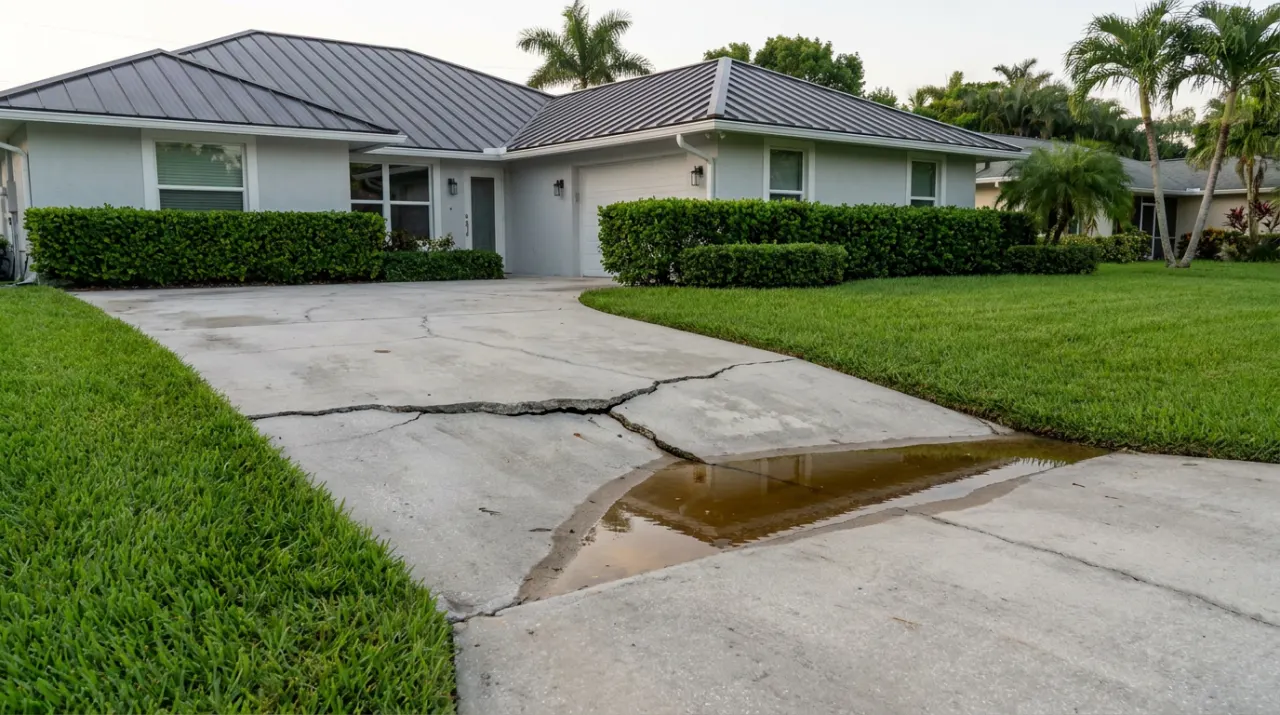
Describe the driveway once in a written scope with photographs: the whole surface from the garage door to the street, close-ups of cracks, roots and sunken spots, the area you want covered, whether you want a poured slab or pavers, what should happen to the old surface, and where rainwater runs off today.
Contact details stay hidden until the homeowner picks a contractor and they confirm the connection.
Source: InstaBids process and privacy, read 15 October 2026.
How can I find driveway contractor records myself?
Check, only if you choose, two dated public records: the Division of Corporations index for the business name on your driveway estimate, and the DBPR examples page that lists installing a driveway or pavers/tile walkways under work that does not need a DBPR license; a result shows what an office listed that day, nothing more.
Source: Division of Corporations records search, read 15 October 2026.
Source: DBPR Unlicensed Activity Program, What Requires a License, read 15 October 2026.
DBPR's What Requires a License page, read 15 October 2026, pairs two entries in one row of its contractor table. Under Needs a DBPR License: "Build a carport or sunroom for compensation." Under Does not need a DBPR License: "Install a driveway or install pavers/tile walkways regardless of compensation." If your plans grow past the driveway into a structure such as a carport, that is a different scope, and you can ask which kind of contractor the company is.
Source: DBPR Unlicensed Activity Program, What Requires a License, read 15 October 2026.
The Division of Corporations describes its site as "the State of Florida's official business entity index and commercial activity website." Look up the exact business name from your driveway estimate and compare it with the payee on each receipt.
Source: Division of Corporations records search, read 15 October 2026.
Store each dated search result with your driveway photographs. A record says what an office listed on one day; the signed scope says what this company agreed to pour or lay.
Next: How InstaBids works, Florida hiring checklist.
InstaBids is in an early pilot in Broward and Palm Beach counties. InstaBids is new in your area, so finding contractors can take longer, and a request may get no bids.
Source: InstaBids process and privacy, read 15 October 2026.
Source: Pilot FAQ, read 15 October 2026.
Sources for the facts on this page
- FTC consumer advice on home improvement contractors, read 15 October 2026.
- FDACS consumer advice on service contractors, read 15 October 2026.
- FDACS complaint routes for businesses, read 15 October 2026.
- Florida Statutes section 556.105, Procedures, 2026 edition, read 15 October 2026.
- Florida Statutes section 556.108, Exemptions, 2026 edition, read 15 October 2026.
- EPA stormwater fact sheet on concrete washout, fact sheet dated February 2012, read 15 October 2026.
- OSHA Silica, Construction, read 15 October 2026.
- DBPR Unlicensed Activity Program, What Requires a License, read 15 October 2026.
- Division of Corporations records search, read 15 October 2026.
- InstaBids process and privacy, live-page excerpts reviewed 15 October 2026.
- Pilot FAQ, live-page excerpt read 15 October 2026.
Parent: InstaBids home.