 InstaBids
What should a concrete driveway estimate include?
A complete concrete driveway estimate states the outline and area, slab thickness, base preparation, reinforcement, joints, finish, old-slab removal, the street apron, drainage, cure time before you drive on it and how you pay, plus a description of the work, the materials, a completion date and the price.
Source: FTC home improvement guidance, read 15 October 2026.
Key facts
- The FTC's home improvement guidance says: "A written estimate should include a description of the work to be done, materials, completion date, and the price."
Source: FTC home improvement guidance, read 15 October 2026.
- The Florida DBPR page What Requires a License lists "Install a driveway or install pavers/tile walkways regardless of compensation." in its table column headed "Does not need a DBPR License".
Source: Florida DBPR What Requires a License, read 15 October 2026.
- The EPA's Concrete Washout stormwater fact sheet says: "If the washwater is dumped on the ground (Fig. 1), it can run off the construction site to adjoining roads and enter roadside storm drains, which discharge to surface waters such as rivers, lakes, or estuaries."
Source: EPA stormwater fact sheet: Concrete Washout, February 2012, read 15 October 2026.
- OSHA's crystalline silica overview says: "Activities such as abrasive blasting with sand; sawing brick or concrete; sanding or drilling into concrete walls; grinding mortar; manufacturing brick, concrete blocks, stone countertops, or ceramic products; and cutting or crushing stone result in worker exposures to respirable crystalline silica dust."
Source: OSHA Silica, Crystalline overview, read 15 October 2026.
- The FTC's home improvement guidance advises: "Don’t pay the full amount for the project up front."
Source: FTC home improvement guidance, read 15 October 2026.
- The Florida DBPR page What Requires a License says: "You should also check with your county or city to learn whether a local business tax receipt or certificate of competency is required for services that do not require a state license."
Source: Florida DBPR What Requires a License, read 15 October 2026.
Which slab details belong in my concrete driveway quote?
Get a written concrete driveway installation quote that marks the outline on a sketch or photograph, names the surface, whether a poured slab, stamped concrete or pavers, and states the base preparation, reinforcement, joint layout, surface finish, removal of the old surface, the apron to the street and a finish date.
Federal consumer advice from the FTC, read 15 October 2026, puts the baseline this way: "A written estimate should include a description of the work to be done, materials, completion date, and the price." A driveway bid needs more than that baseline, so put the questions below to every bidder in the same order.
Source: FTC home improvement guidance, read 15 October 2026.
- Outline and area: Where does the new surface start and stop, does it include any widening, walkway or turnaround, and what area does the quote cover?
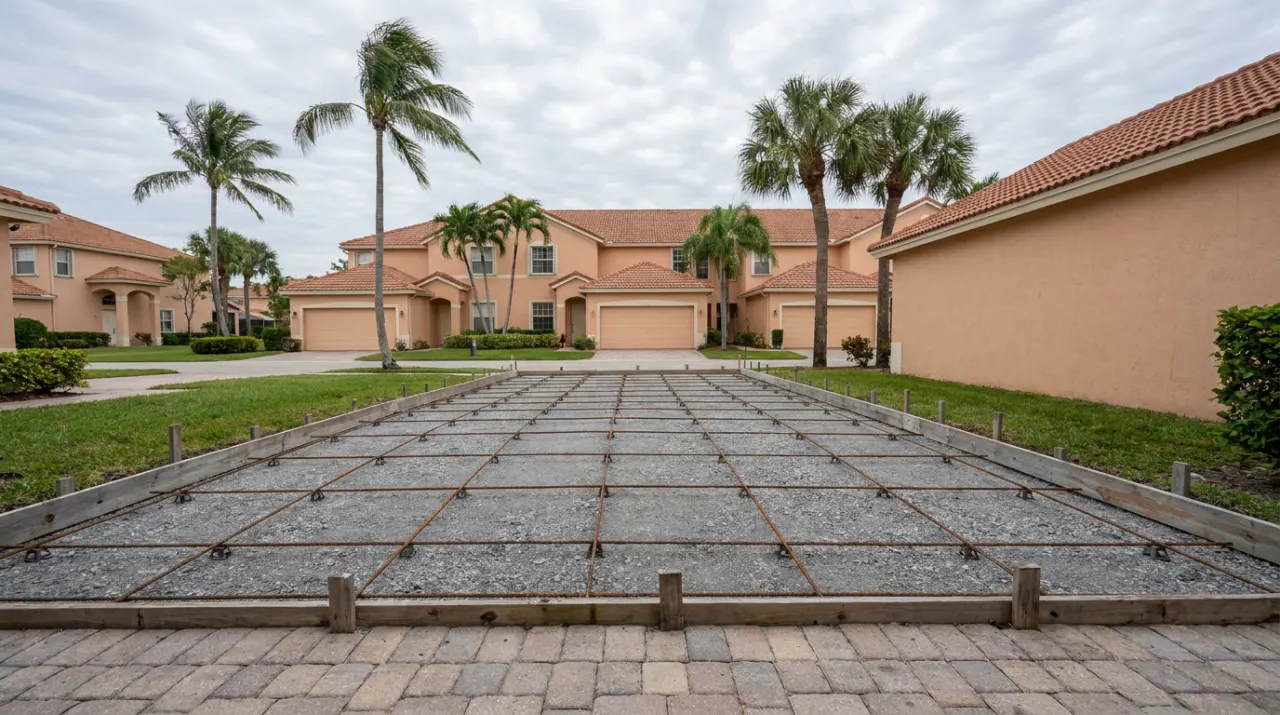
- Thickness and base: What slab thickness or paver depth is proposed, what base material goes underneath, and how is that base compacted before the pour or the bedding layer?
- Reinforcement: Does the quote propose wire mesh, rebar, fiber or nothing at all, and does it say so in writing rather than leaving it to the day of the pour?
- Joints: Where will control joints be cut or tooled, and is there an expansion joint where the driveway meets the garage slab, a sidewalk or the house?
- Finish: Is the surface broom-finished, stamped, colored or exposed aggregate, and is a sealer included, with the timing and who applies it?
- Curing and first use: How long does the bidder ask you to keep cars off, and how is the new concrete kept moist or covered while it cures?
Ask a paver bidder the same questions in paver terms: the depth of the compacted base, the bedding sand, the joint sand, and the edge restraint that keeps the outer row from creeping outward. Get the paver style, color and laying pattern written down, along with whether spare pavers are left with you for later repairs.
InstaBids gets you competitive written quotes without calls or home visits to bid; contractors never pay to see a request or to bid, and there is no fee during our pilot.
Post your requestWhat site work might my concrete driveway quote omit?
Check your concrete driveway installation quote against a list of easily missed lines: breaking out and hauling the old slab, cutting tree roots, regrading for runoff, the street apron, sprinkler line repairs, dust from saw cutting and where the trucks wash out. Get each missing answer written in as a line item.
Ask who arranges the underground utility locate before the old slab is broken out or the base is dug. Florida Statutes s. 556.102(4), read 15 October 2026, states: "“Demolish” or “demolition” means any operation by which a structure or mass of material is wrecked, razed, rended, moved, or removed by means of any tool, equipment, or discharge of explosives, or any disturbance of the earth in any manner on public or private lands which could damage any underground facility."
Source: Florida Statutes s. 556.102, Definitions, read 15 October 2026.
Section 556.105(1)(a), read the same day, opens: "Not less than 2 full business days before beginning any excavation or demolition that is not beneath the waters of the state, and not less than 10 full business days before beginning any excavation or demolition that is beneath the waters of the state, an excavator shall provide the following information through the system:" Ask the bidder whether it treats your job as covered by these sections and, if so, who gives that notice.
Source: Florida Statutes s. 556.105, Procedures, read 15 October 2026.
Section 556.108 lists exemptions from that notice, so ask the bidder whether any applies to your driveway.
Source: Florida Statutes s. 556.108, Exemptions, read 15 October 2026.
Ask where the truck chutes, wheelbarrows and hand tools will be rinsed. The EPA's Concrete Washout stormwater fact sheet, dated February 2012 and read 15 October 2026, says: "If the washwater is dumped on the ground (Fig. 1), it can run off the construction site to adjoining roads and enter roadside storm drains, which discharge to surface waters such as rivers, lakes, or estuaries." Request that the quote say where washout goes and who removes it.
Source: EPA stormwater fact sheet: Concrete Washout, February 2012, read 15 October 2026.
Ask how saw cutting of joints and of the old slab is handled for dust. OSHA's crystalline silica overview, read 15 October 2026, says: "Activities such as abrasive blasting with sand; sawing brick or concrete; sanding or drilling into concrete walls; grinding mortar; manufacturing brick, concrete blocks, stone countertops, or ceramic products; and cutting or crushing stone result in worker exposures to respirable crystalline silica dust." Ask whether the crew cuts wet or uses dust collection, and whether parked cars, windows and a pool are covered meanwhile.
Source: OSHA Silica, Crystalline overview, read 15 October 2026.
Ask what happens where tree roots have lifted the old slab or cross the new outline, whether any roots will be cut, and whether that work sits inside this quote. Find out which way the finished surface slopes and where rainwater leaves it, so water heads toward the street or lawn rather than the garage door.
Which pour stages should my payment schedule describe?
Check that your concrete driveway installation payment schedule follows stages you can see: old surface removed and hauled away, base graded and compacted, concrete poured or pavers laid, then a walk-through after cleanup and the cure period. Agree that extra base fill or root work found after demolition needs your signed change order before it is billed.
On deposits, the FTC's consumer advice, read 15 October 2026, opens one tip with: "Don’t pay the full amount for the project up front."
Source: FTC home improvement guidance, read 15 October 2026.
The same tip closes with: "And never make the final payment until the work is done and you’re satisfied with it." For a driveway, ask whether the bidder counts the work as done before the cure period ends and the street apron is cleaned up.
Source: FTC home improvement guidance, read 15 October 2026.
Ask whether ready-mixed concrete or pallets of pavers are paid for on delivery, and whether a pour pushed back by rain moves any payment date. Keep demolition, base work, the pour or paver laying, and the apron as separate payment lines so each one can be matched to work you have seen finished.
The FTC's contract checklist, read 15 October 2026, ends with: "And, make sure all blank spaces are filled in." Look for blank start dates, empty thickness or finish lines and unfilled payment amounts before you sign.
Source: FTC home improvement guidance, read 15 October 2026.
Who handles permits for the quoted driveway and apron?
Ask who applies for any permit your town or county issues for the driveway or the apron at the street, who books inspections, who receives the closeout record, and which business name appears on that paperwork. Put the answers into the written quote before the old slab comes out.
Ask whether the apron, the strip between your property line and the street, falls under a different office from the driveway itself, and who deals with that office. If any permit applies, ask whether your last payment is held until its inspection is closed.
On state licensing, the Florida DBPR page What Requires a License, read 15 October 2026, lists "Install a driveway or install pavers/tile walkways regardless of compensation." in the table column headed "Does not need a DBPR License".
Source: Florida DBPR What Requires a License, read 15 October 2026.
The same page adds: "You should also check with your county or city to learn whether a local business tax receipt or certificate of competency is required for services that do not require a state license." Ask each bidder which local record, if any, it holds for driveway work in your city or county.
Source: Florida DBPR What Requires a License, read 15 October 2026.
The same page's Contractors section states: "Essentially, if you pay someone to construct a building or a structure, make structural alterations to load bearing walls, or perform services such as plumbing or air conditioning work, that person must have a state contractors’ license." If your job also includes a foundation, a slab under a building or a structural wall, ask each bidder how that DBPR statement applies to that part of the work. Looking up a bidder in any public record is your own optional step.
Source: Florida DBPR What Requires a License, read 15 October 2026.
What access details should my concrete driveway request include?
Describe the driveway in one written scope: the outline, the surface you want, the old material to remove, the apron to the street and any walkway, then add a photograph of the whole driveway from the street, each crack or lifted section, nearby tree trunks and the path rainwater takes.
Note how a concrete truck or pump would reach the work, any gate, overhead line or low branch along that route, and where your cars will park while the new surface cures.
Contact details stay hidden until the homeowner picks a contractor and they confirm the connection.
Source: InstaBids process and privacy, read 15 October 2026.
How can I compare concrete driveway quotes for base and joints?
Compare concrete driveway installation quotes line by line: the same outline and area, then thickness and base, reinforcement, joint layout, finish, old-slab removal, apron work, washout and dust handling, and the start and finish dates. Any bid that strays from your written scope owes you a written explanation before you choose.
- Base: Which bids name the base material and the compaction method, and which leave the base unstated?
- Reinforcement and joints: Are reinforcement and joint spacing spelled out in every bid, or missing from one?
- Removal: Is the whole old slab, apron included, broken out and hauled away, or only part of it?
- Finish and sealer: Is the finish identical across bids, and is sealing in or out?
- Timing: Which bids state a start, a finish and the days before cars can use the surface?
List a different surface, such as pavers in place of a broom-finished slab, as an alternative beside your original line so it never quietly replaces your scope. A drainage problem or cracked garage slab edge that one bidder spots belongs in an updated written scope that goes back to all of them.
Use that same written scope, with its outline, base, joint, removal and apron answers, each time you ask for competing written responses.
Next: How InstaBids works, Florida hiring checklist.
InstaBids is in an early pilot in Broward and Palm Beach counties. InstaBids is new in your area, so finding contractors can take longer, and a request may get no bids.
Source: InstaBids process and privacy, read 15 October 2026.
Source: Pilot FAQ, read 15 October 2026.
Sources for the facts on this page
Sources checked: 15 October 2026.
- Pilot FAQ, live-page excerpt read 15 October 2026.
- InstaBids process and privacy, live-page excerpts reviewed 15 October 2026.
- FTC home improvement guidance, checked 15 October 2026.
- Florida Statutes s. 556.102, Definitions, checked 15 October 2026.
- Florida Statutes s. 556.105, Procedures, checked 15 October 2026.
- Florida Statutes s. 556.108, Exemptions, checked 15 October 2026.
- EPA stormwater fact sheet: Concrete Washout, February 2012, checked 15 October 2026.
- OSHA Silica, Crystalline overview, checked 15 October 2026.
- Florida DBPR What Requires a License, checked 15 October 2026.
Parent: InstaBids home.